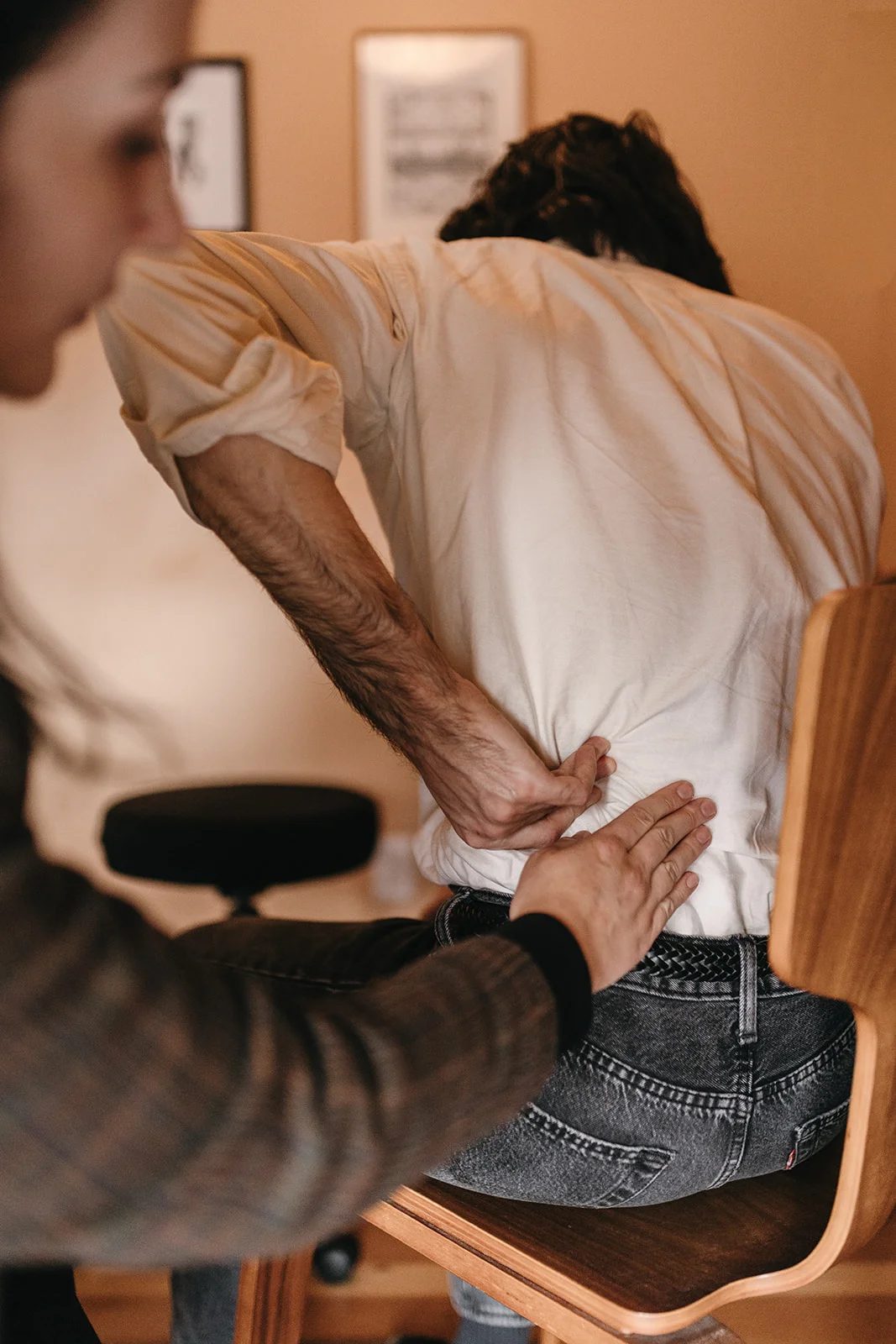
Tech neck: what desk work does to your neck and shoulders, and what helps

Portland's work-from-home years left a lot of people with a laptop on a kitchen table, a chair meant for dinner, and a neck that aches by three in the afternoon. "Tech neck" is the nickname. The pattern underneath it is old: hours of a head held forward over a screen, shoulders drifting up, the muscles that run from the base of the skull to the shoulder blades doing a job they were not built to do all day.
The short answer: desk-related neck pain is extremely common and rarely dangerous, and the two things with the best evidence are moving differently and getting stronger. Massage can ease things in the short term, though the research on lasting change from it is thin; physical therapy is where the lasting change tends to come from. Most people do best with both, plus a few honest changes to the desk itself.
How common it is
An international task force on neck pain found that 11 to 14 percent of workers are limited in their activities by neck pain each year, and those are the limited cases, not the sore-by-Friday ones. [2] Office workers get enough of it that a 2018 review in Physical Therapy could pool trials of workplace neck-pain programs built for that group alone. [1] That is not a niche complaint. In a building full of desks, it is a lot of people.
Posture alone does not explain it; the research on "forward head posture" as a cause is mixed. What is clearer is that long static hours, low movement, and stress each contribute, and that the fix has to address all three.
What massage can and cannot do

Massage is the first thing most people with a tight neck reach for, and it is a reasonable instinct. The honest summary from the Cochrane review on massage for neck pain, updated in 2024, is that the evidence is mostly low-certainty, and that for pain lasting more than a few weeks massage may make little or no difference compared with a placebo when measured around twelve weeks out. [3] What people come in for is how they feel afterward, and short-term relief is not nothing: it breaks the cycle of guarding, lets you sleep, and makes the exercises easier to do.
Massage at Mandala is 60 minutes, with eight licensed therapists across deep tissue, myofascial, Swedish, prenatal, and more, three of whom can add cupping to a neck and shoulder session. [5] Tell your therapist it is a desk neck. The work will focus on the upper trapezius, levator scapulae, the suboccipitals at the base of the skull, and the muscles along the shoulder blade, with time on the chest, which tightens as the shoulders roll forward.
Where physical therapy comes in
If the pain keeps returning, the question changes from "how do I loosen this" to "why does it keep tightening." That is a physical therapy question. The Cochrane review on exercise for mechanical neck disorders found that strengthening and endurance work for the neck and shoulder girdle may help with chronic neck pain and function, and that stretching alone, on low-quality evidence, may not change pain or function. [4] A lot of people have been stretching a tight neck for years, feeling better for an hour, and wondering why nothing changes.
Physical therapy here is with Katy Kemp, DPT, whose practice includes orthopedic and chronic pain work alongside sports rehab. [5] A first visit looks at how your neck, upper back, and shoulders move together, how long you can hold your head up without the muscles fatiguing, and what your desk setup is asking of you. You leave with a short strength program, usually five or ten minutes a day, and a plan to progress it. Visits are 50 minutes, in person or by telehealth, which suits a desk problem well: Katy can see the desk. [5]
Changing the desk as well as the neck

A few changes cost nothing. The task force found that changing the workstation on its own did not reduce how often neck pain started, so treat these as the floor and pair them with the strength work: [2]
- Screen at eye level. A laptop on a table puts your head down all day. A stack of books and an external keyboard fix it for twenty dollars.
- Move every thirty to forty-five minutes. Stand, walk to the window, roll the shoulders. The best posture is the next one.
- Elbows supported, shoulders down. If your shoulders are near your ears while you type, the chair or desk height is wrong.
- Phone up, not head down. Ten minutes of scrolling with your chin on your chest is a lot of load for small muscles.
- Notice the stress. Shoulders climb when a deadline does. Breathing out slowly, a few times an hour, drops them more reliably than any stretch.
If your employer offers a wellness or ergonomics benefit, our employer benefits guide explains how to use it here.
When neck pain needs a doctor first
Most desk neck is muscular. See a physician before booking with us if you have numbness, tingling, or weakness in an arm or hand, pain after a fall or crash, a fever with a stiff neck, or pain that is constant and worsening regardless of position. For neck pain after a car accident, our car accident care page explains how that works.
For everyone else: a massage to break the cycle, a physical therapy visit to change the pattern, and a laptop stand. Book a massage or a physical therapy visit, and bring a photo of your desk.
Sources
- Chen X, Coombes BK, Sjøgaard G, Jun D, O'Leary S, Johnston V. "Workplace-Based Interventions for Neck Pain in Office Workers: Systematic Review and Meta-Analysis." Physical Therapy, 2018;98(1):40-62. PMID 29088401.
- Côté P, van der Velde G, Cassidy JD, et al. "The burden and determinants of neck pain in workers: results of the Bone and Joint Decade 2000-2010 Task Force on Neck Pain and Its Associated Disorders." Spine, 2008;33(4 Suppl):S60-74. PMID 18204402.
- Gross AR, Lee H, Ezzo J, et al. "Massage for neck pain." Cochrane Database of Systematic Reviews, 2024;2:CD004871 (update of the 2012 review; low-certainty evidence, little or no difference versus placebo for subacute and chronic neck pain at about 12 weeks). PMID 38415786.
- Gross A, Kay TM, Paquin JP, et al. "Exercises for mechanical neck disorders." Cochrane Database of Systematic Reviews, 2015;(1):CD004250. PMID 25629215.
- Mandala Medicine & Wellness, massage and physical therapy service pages and Katy Kemp, DPT bio (session lengths, therapist count and styles, which three therapists offer cupping, in-person or telehealth visits), read 2026-10-07. https://mandalamed.com/services/massage and https://mandalamed.com/services/physical-therapy
Questions
Massage can give short-term relief; physical therapy addresses why the pain keeps returning. If this is a once-a-year flare after a hard week, start with massage. If it is every month, start with PT, and use massage alongside it.
Probably not on its own. The Cochrane review on neck exercise found, on low-quality evidence, that stretching alone may not change chronic neck pain or function, while strengthening and endurance work for the neck and shoulders may help. Stretching can feel good between strength sessions; it is not the treatment.
That depends on how long the pattern has been building. Many people feel a difference after one session and book every few weeks while they build strength and fix the desk. Your therapist will suggest a cadence after the first visit.
Yes. Visits can be in person or by video, and for a desk problem video is often better: Katy can see your actual setup and adjust it with you.
Not by itself. Standing still for hours has its own problems. The win is changing position often, with the screen at eye level either way.